The supplement industry has split into two camps. On one side: personalized supplement companies that use quizzes, algorithms, and DNA tests to build you a custom stack. On the other: clinical-dose formulas that pack research-backed doses of targeted ingredients into purpose-built products.
Both approaches have merit. Both have marketing claims that sound compelling. But when you dig into the science, the dosing, and the actual results — one approach has significantly more evidence behind it than the other.
In this guide, we will compare the personalized supplement model (think Thesis, Care/of, Persona) with the clinical-dose approach (think formulas built around peer-reviewed research at effective doses) to help you decide which is worth your money.
How Personalized Supplements Work
The personalized supplement model follows a general pattern:
- Take a quiz: You answer questions about your goals, lifestyle, diet, sleep, stress levels, and health concerns
- Get a recommendation: An algorithm (or in some cases, a "nutritionist review") generates a custom supplement stack
- Receive your pack: Monthly shipment of pills, typically 4-8 capsules per day across multiple formulas
- Iterate: Some brands encourage you to adjust based on how you feel
The Appeal of Personalization
The concept is attractive: instead of guessing which supplement to take, an algorithm tailors a stack to your specific needs. It feels scientific. It feels premium. And the unboxing experience — custom labels, your name on the pack — feels like luxury.
Thesis, for example, positions their nootropic blends as personalized cognitive support. You take a quiz, and they recommend specific "blends" (Energy, Clarity, Motivation, Creativity, etc.) for you to try and rotate.
The Reality of Quiz-Based Personalization
Here is where it gets complicated. When researchers and formulators evaluate these quiz-based systems, several issues emerge:
1. Limited personalization depth. A 10-15 question quiz cannot meaningfully capture your biochemistry. Real personalization would require blood work, genetic testing, microbiome analysis, and medical history review. A quiz asking "How stressed are you on a scale of 1-5?" is not clinical personalization — it is market segmentation.
2. The same few formulas for everyone. Most personalized supplement companies have a fixed inventory of 6-12 pre-made formulas. The "personalization" is which combination of these existing products you receive. You are not getting a formula mixed specifically for you — you are getting a curated selection from a limited menu.
3. Sub-clinical dosing across many ingredients. When you spread your daily capsule count across 4-6 different formulas, each containing multiple ingredients, the per-ingredient dose often falls below clinical thresholds. A formula might contain ashwagandha, but at 100mg instead of the clinically studied 300-600mg. It is on the label, but it is not at the dose shown to work in research.
4. The "personalized" premium. Personalized supplement subscriptions typically cost $60-$120+ per month. A significant portion of that cost goes toward the quiz infrastructure, custom packaging, and multi-product logistics — not toward higher-quality ingredients or doses.
How Clinical-Dose Formulas Work
The clinical-dose approach is fundamentally different in philosophy:
- Start with the research: Identify which ingredients have randomized controlled trial (RCT) evidence for a specific outcome
- Use the studied doses: Include each ingredient at the milligram amount shown to be effective in clinical trials — not token amounts
- Combine complementary mechanisms: Select ingredients that work through different pathways for synergistic support
- Disclose everything: List exact doses on the label so consumers can verify against published research
What "Clinical Dose" Actually Means
A clinical dose is the specific amount of an ingredient used in peer-reviewed human studies that demonstrated measurable, statistically significant results. For example:
- Ashwagandha: A prospective, randomized double-blind, placebo-controlled study (PubMed) found that 300mg twice daily reduced serum cortisol by 27.9% in adults with chronic stress
- L-Theanine: Research published in Asia Pacific Journal of Clinical Nutrition (PubMed) showed that L-theanine significantly increases alpha brain wave activity, indicating relaxation without drowsiness
- Ginger extract: A randomized double-blind study (PubMed) demonstrated that 1,200mg of ginger accelerates gastric emptying and stimulates antral contractions in healthy volunteers
- Bromelain: Research reviews (PubMed) confirm bromelain supports protein digestion and nutrient absorption, with the body able to absorb up to 12g daily without major side effects
The key distinction: if a study used 300mg of ashwagandha and showed results, a product containing 50mg of ashwagandha cannot claim the same expected benefit. The dose matters as much as the ingredient itself.
Head-to-Head Comparison
| Factor | Personalized (Quiz-Based) | Clinical-Dose Formulas |
|---|---|---|
| How it works | Quiz assigns pre-made formulas | Purpose-built around research |
| Ingredient doses | Often sub-clinical (spread thin) | Matched to clinical trial doses |
| Transparency | Varies; some use proprietary blends | Full dose disclosure on label |
| Number of pills/day | 4-8+ across multiple products | 2-5 per targeted product |
| Monthly cost | $60-$120+ | $39-$90 (varies by product) |
| Personalization depth | Surface-level (quiz-based) | Self-selected by concern |
| Testing | Varies by brand | Triple third-party tested (best brands) |
| Convenience | Custom daily packs | Single-serve sachets (some brands) |
The Dosing Problem in Personalized Supplements
This is the most critical issue, so let us unpack it with an example.
Imagine a personalized supplement company recommends you take their "Calm" blend, "Focus" blend, and "Energy" blend — 6 capsules total per day. Each blend contains 4-6 ingredients. That is 12-18 ingredients spread across 6 capsules.
The math problem: a standard capsule holds approximately 500-750mg of total material. Six capsules hold roughly 3,000-4,500mg total. Spread across 12-18 ingredients, each ingredient averages 167-375mg. For many ingredients, that is below the clinical threshold.
Compare this to a clinical-dose formula targeting one specific concern. Anxiety Assassin by Mortals, for example, puts 9 ingredients into 3 capsules — but those 3 capsules are packed with clinical doses matched to published research. The formula is designed for one purpose: anxiety support. Every milligram is allocated toward that single goal.
When Personalization Makes Sense
To be fair, the personalized model is not without value:
- Discovery: If you have no idea where to start, a quiz can point you in a general direction
- Convenience: Having someone else curate your stack saves research time
- Variety: If your needs span multiple categories (sleep + focus + digestion), a multi-product system covers more ground
- Adherence: Custom daily packs can improve consistency — research shows simpler regimens lead to better compliance (PubMed), and you are more likely to take something that feels "made for you"
The personalized model works best as a starting point for supplement beginners who need guidance and are willing to pay a premium for curation.
When Clinical-Dose Formulas Make More Sense
The clinical-dose approach tends to win when:
- You know your primary concern: Anxiety, digestive issues, pain, menstrual discomfort — if you know what you need help with, a targeted formula is more efficient
- Dosing matters to you: If you want to verify that every ingredient matches published research, full dose disclosure is essential
- Value matters: Dollar-for-dollar, clinical-dose formulas typically deliver more active ingredient per serving
- Speed of results matters: Higher per-ingredient doses tend to produce noticeable effects faster
- You want simplicity: One targeted product vs managing 4-6 different bottles
What the Research Says About Dosing
The clinical evidence overwhelmingly supports the principle that dose determines outcome. This is called the dose-response relationship, and it is a foundational concept in pharmacology and nutritional science (PubMed).
Research in clinical pharmacology (PMC) has established that knowledge of dose-concentration-response relationships is essential for safe and effective use of compounds in individual patients. The ED50 — the dose producing an effect in 50% of a population — serves as a clinical starting point, with adjustments needed based on individual factors.
This principle applies directly to supplements: many commercial products contain ingredients at doses too low to produce the effects demonstrated in clinical trials. The authors of pharmacological research note that "label claim" does not equal "clinical efficacy" — a critical distinction for consumers to understand.
The Mortals Approach: Targeted Clinical Doses
Full disclosure: we have a perspective here. Mortals was built specifically as an alternative to the sub-clinical dosing problem.
Each Mortals product targets one specific concern with clinical-dose ingredients:
- Anxiety Assassin: 9 ingredients including ashwagandha (PubMed), L-theanine (PubMed), GABA (PubMed), lion's mane (PubMed), passionflower (PubMed), chamomile, valerian root (PubMed), lemon balm, and magnesium bisglycinate (PubMed) (3 caps, 20-45 min onset)
- Pain Purge: 7 ingredients including turmeric with BioPerine (PubMed), boswellia, white willow bark, bromelain (PubMed), ginger (PubMed), and magnesium (4 caps, 30-60 min onset)
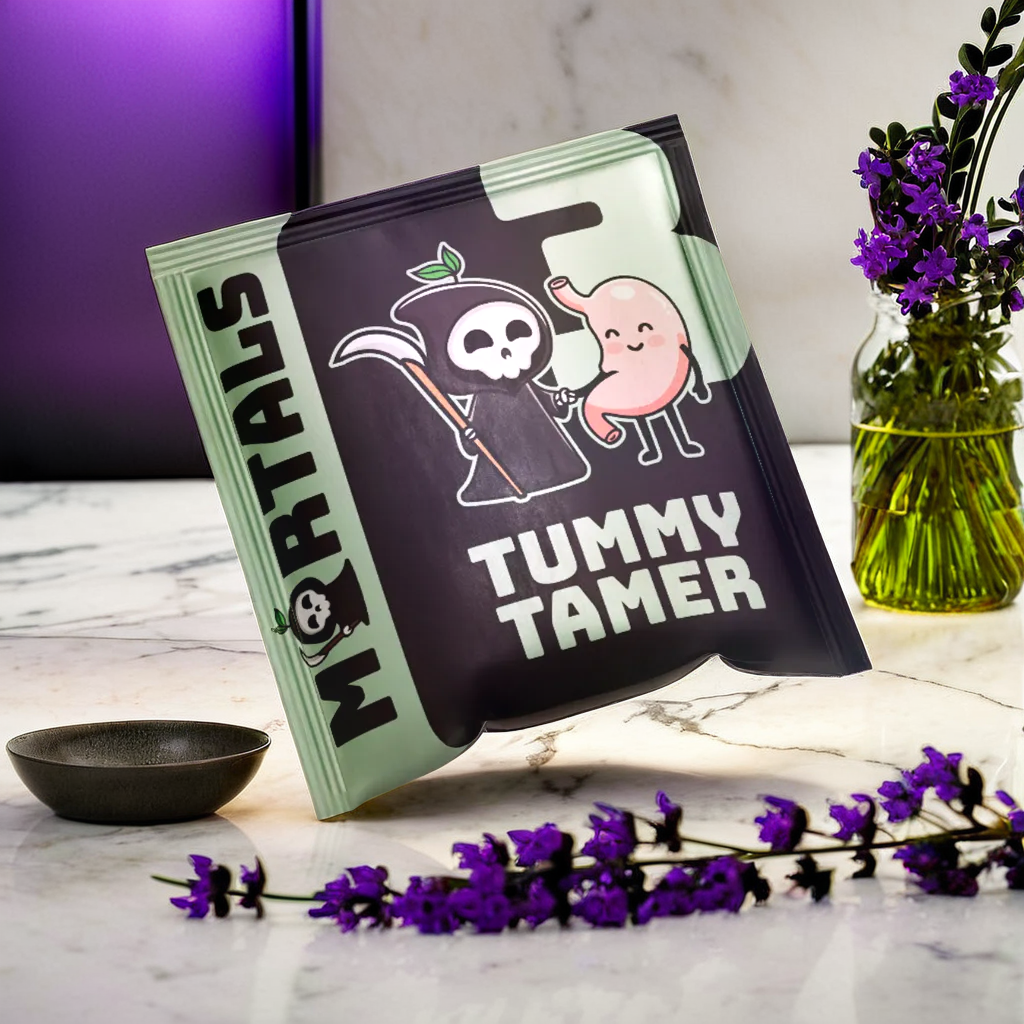
- Tummy Tamer: 8 ingredients plus probiotics including ginger (PubMed), artichoke, dandelion, bromelain, aloe vera, lemon balm, licorice root, and a probiotic blend (2 caps, 15-30 min onset)
- Cramp Crusher: 17 ingredients including black cohosh, chaste tree berry, magnesium, dong quai, and more (5 caps, 30-45 min onset)
Every ingredient is listed with its exact dose. Every product is triple third-party tested. And the single-serve sachet format means you grab one pack when you need it — no pill organizers, no daily pack subscriptions, no guessing.
You can try all four with a sample pack to find which formula fits your needs — a different kind of "personalization" that is based on real experience rather than quiz answers.
How to Evaluate Any Supplement (Personalized or Not)
Regardless of which model you choose, ask these questions before purchasing:
- Are individual ingredient doses listed? If a brand hides behind "proprietary blends," you cannot verify clinical dosing.
- Do the doses match published research? Look up the key ingredients on PubMed and compare the studied dose to what is in the product.
- Is it third-party tested? Independent testing verifies that what is on the label is actually in the product.
- What is the cost per clinically-dosed serving? Not cost per pill — cost per serving that delivers effective doses.
- Does the company disclose their sourcing? Where ingredients are sourced and manufactured matters for quality and potency.
These questions protect you whether you are buying a $120 personalized stack or a $39 targeted formula. The supplement that works is the one that contains effective doses of evidence-based ingredients — regardless of how it was recommended to you.
As always, consult your healthcare provider before starting any new supplement regimen.
Frequently Asked Questions
Are personalized supplements better than regular supplements?
Not necessarily. "Personalized" refers to how products are recommended to you (via quiz), not to the quality or dosing of the ingredients. A well-formulated clinical-dose supplement targeting your specific concern may deliver better results than a personalized stack with sub-clinical doses spread across many goals.
What does clinical dose mean?
A clinical dose is the specific milligram amount of an ingredient shown to produce measurable results in peer-reviewed human studies. For example, 300mg of ashwagandha twice daily is a clinical dose based on multiple randomized controlled trials (PubMed). Many supplements include ingredients at lower amounts that have not been independently studied for efficacy.
Why do personalized supplements cost more?
The premium largely covers quiz infrastructure, algorithm development, custom packaging, multi-product logistics, and marketing. These are real costs, but they do not necessarily translate to higher-quality ingredients or more effective doses. When comparing value, look at the cost per clinically-dosed serving rather than the monthly subscription price.
How do I know if my supplement is actually working?
Give targeted supplements at least 2-4 weeks of consistent use (some adaptogens need 6-8 weeks). Track specific metrics: sleep quality, anxiety levels, digestive comfort, or pain frequency. If you notice meaningful improvement in your target area, the formula is likely delivering effective doses. If nothing changes after 4-8 weeks of consistent use, the doses may be too low or the ingredients may not be right for your specific situation.
Can I combine personalized and clinical-dose approaches?
Yes. Some people use a personalized quiz for general wellness (multivitamins, omega-3s, vitamin D) and add a targeted clinical-dose formula for their primary concern (anxiety, digestion, pain). The key is ensuring you are not duplicating ingredients at combined doses that exceed recommended amounts.
Written by Connor. Connor is the founder of Mortals, an all-natural supplement brand focused on clinical dosing. After years of frustration with underdosed supplements and misleading labels, he created Mortals to deliver what the research actually supports.
*These statements have not been evaluated by the Food and Drug Administration. This product is not intended to diagnose, treat, cure, or prevent any disease. Always consult your healthcare provider before starting any new supplement regimen.