Walk into any supplement aisle and you will see the same thing: rows of plastic bottles filled with pills, capsules, and powders. This model has dominated the supplement industry for decades. But it has a fundamental flaw that most consumers never think about — and it is costing them potency, convenience, and results.
Single-serve supplement sachets are changing the game, and the shift is happening fast. The global supplements and nutrition packaging market is projected to reach $49 billion by 2034, growing at 5.93% annually. Stick packs and sachets are the fastest-growing format in the category. Here is why.
The Supplement Industry Has a Packaging Problem
Traditional supplement bottles have a design flaw that is hiding in plain sight: every time you open the bottle, you expose every remaining dose to air, moisture, and light. These are the three biggest enemies of supplement potency.
- Oxidation begins immediately. When you break the seal on a supplement bottle, oxygen starts degrading sensitive ingredients. Research shows that vitamins and antioxidants are particularly vulnerable to oxidation during storage (PMC). Vitamin A degradation can exceed 45% within 3 months under mild conditions, while vitamin C is particularly affected by packaging type — studies show complete oxidation can occur within one month in bottles without proper oxygen barriers (PubMed). By the time you reach the last pills in a 90-count bottle, those doses may have significantly less potency than the first ones you took.
- Moisture accelerates degradation. Every time you open a bottle — especially in a humid bathroom — moisture enters and interacts with the ingredients. This is particularly problematic for probiotics, which are highly sensitive to environmental moisture. Research confirms that probiotic stability increases with decreasing moisture content, and humidity can cause uneven rehydration and membrane rupture in dried probiotic formulations (PubMed).
- Most people do not finish bottles before potency declines. Supplement adherence rates are notoriously low. If you miss days here and there, that bottle sits open longer, and every remaining dose degrades further. You end up paying for full-potency supplements but consuming reduced-potency ones.
Why Single-Serve Sachets Are Taking Over
The shift toward single-serve supplement formats is being driven by several converging trends:
- On-the-go lifestyles. People want supplements they can toss in a bag, keep in a desk drawer, or take while traveling — without carrying bulky bottles.
- Personalized nutrition. Single-serve formats make it easy to take different supplements on different days based on your needs. Feeling anxious? Grab one sachet. Digestive discomfort? Grab a different one. This flexibility is impossible with traditional bottles.
- Post-COVID health awareness. The pandemic accelerated interest in proactive health and immune support. Consumers are more informed, more discerning, and more willing to pay for quality — including better packaging and delivery formats.
- Subscription and DTC models. Direct-to-consumer supplement brands are driving innovation in packaging because they are not constrained by traditional retail shelf requirements.
5 Advantages of Sachets Over Bottles
1. Freshness — Each Dose Sealed Until Use
This is the single biggest advantage. Each sachet is individually sealed, creating a barrier against air, moisture, and light until the moment you open it. Your last sachet is just as fresh and potent as your first. This is particularly critical for sensitive ingredients like probiotics — research shows that oxygen toxicity is widely responsible for cell death in probiotic bacteria, and these bacteria lack sufficient ROS-scavenging enzymes to protect against oxidative stress (PubMed).
2. Precise Dosing — Pre-Measured, No Guessing
With traditional bottles, you are responsible for counting pills, measuring scoops, or splitting tablets. It sounds simple, but dosing inconsistency is a real problem. Scoops of powder can vary by 20-30% depending on how tightly you pack them. With sachets, every dose is pre-measured at the manufacturing facility with precision equipment. You get exactly what the label says, every time.
3. Portability — Pocket and Purse-Friendly
A single sachet is slim, lightweight, and fits anywhere. Keep one in your wallet, your gym bag, your travel kit, or your desk at work. Try doing that with a bottle of 90 capsules. Sachets are also TSA-friendly — they do not count toward liquid limits and do not require you to pack a bulky bottle in your carry-on.
4. No Pill Fatigue
Supplement fatigue is real. When you have multiple bottles to manage — open bottle A, take 2 pills, open bottle B, take 3 pills, open bottle C — it becomes a chore. Many people simply stop taking supplements because the routine is too cumbersome. Single-serve sachets reduce this to one step: open one packet, take the contents. Done.
5. Better Compliance — Easier to Remember and Take Consistently
Research consistently shows that simpler supplement and medication routines lead to better adherence. A systematic review found that adherence was significantly higher among patients taking medications with once-daily dosing compared to thrice or more frequent dosing (PMC). Clinical trials on unit-dose packaging show significant improvements in compliance — one study found compliance rates of 86.7% vs 66.7% with unit-dose calendar packaging compared to conventional bottles (PubMed). When taking your supplements requires opening a single sachet instead of managing multiple bottles, you are far more likely to actually take them every day. And consistency is where supplement benefits come from — sporadic use of even the best supplements delivers minimal results.
The Clinical Dosing Connection
Here is something most people do not realize: the sachet format actually enables better formulation. Here is why.
Clinical doses of effective ingredients require volume. When a study shows that 600mg of ashwagandha reduces cortisol — as demonstrated in a randomized, double-blind, placebo-controlled trial (PubMed) — you need 600mg in your supplement — not 50mg sprinkled into a two-capsule serving so it looks good on the label. This practice of using sub-clinical amounts of ingredients is called "pixie-dusting," and it is rampant in the supplement industry.
Sachets containing 2-5 capsules can deliver full clinical doses of multiple ingredients in a single serving. A traditional supplement constrained to 1-2 capsules per serving simply cannot fit enough active ingredients at meaningful doses. The math does not work.
This is exactly why Mortals uses the sachet format. Each product delivers clinical doses of 7-17 ingredients in a single pre-measured sachet — something that would be impossible in a standard two-capsule serving size. When you see a supplement with 15 ingredients in a two-capsule serving, you can be virtually certain that most of those ingredients are at sub-clinical doses.
What to Look for in Single-Serve Supplements
Not all single-serve supplements are created equal. Here is what separates the good from the great:
- Ingredient transparency. Every ingredient and its exact dose should be listed on the label. No proprietary blends, no hidden formulas. If a brand will not tell you exactly how much of each ingredient is in their product, that is a red flag — they are likely hiding sub-clinical doses.
- Clinical doses listed per sachet. The dose per sachet should match or exceed what clinical studies used to demonstrate effectiveness. If a study used 500mg and the product contains 50mg, you are not getting what the research supports. The dose-response relationship is foundational in pharmacology (PubMed).
- Third-party testing verification. Independent lab testing confirms that what is on the label is actually in the product — and that contaminants like heavy metals, pesticides, and microbes are below safe thresholds. Look for brands that test multiple times, not just once.
- USA manufacturing in cGMP facilities. Current Good Manufacturing Practice (cGMP) certification means the facility follows FDA-established quality standards for supplement production. This is the baseline for quality — not a premium feature.
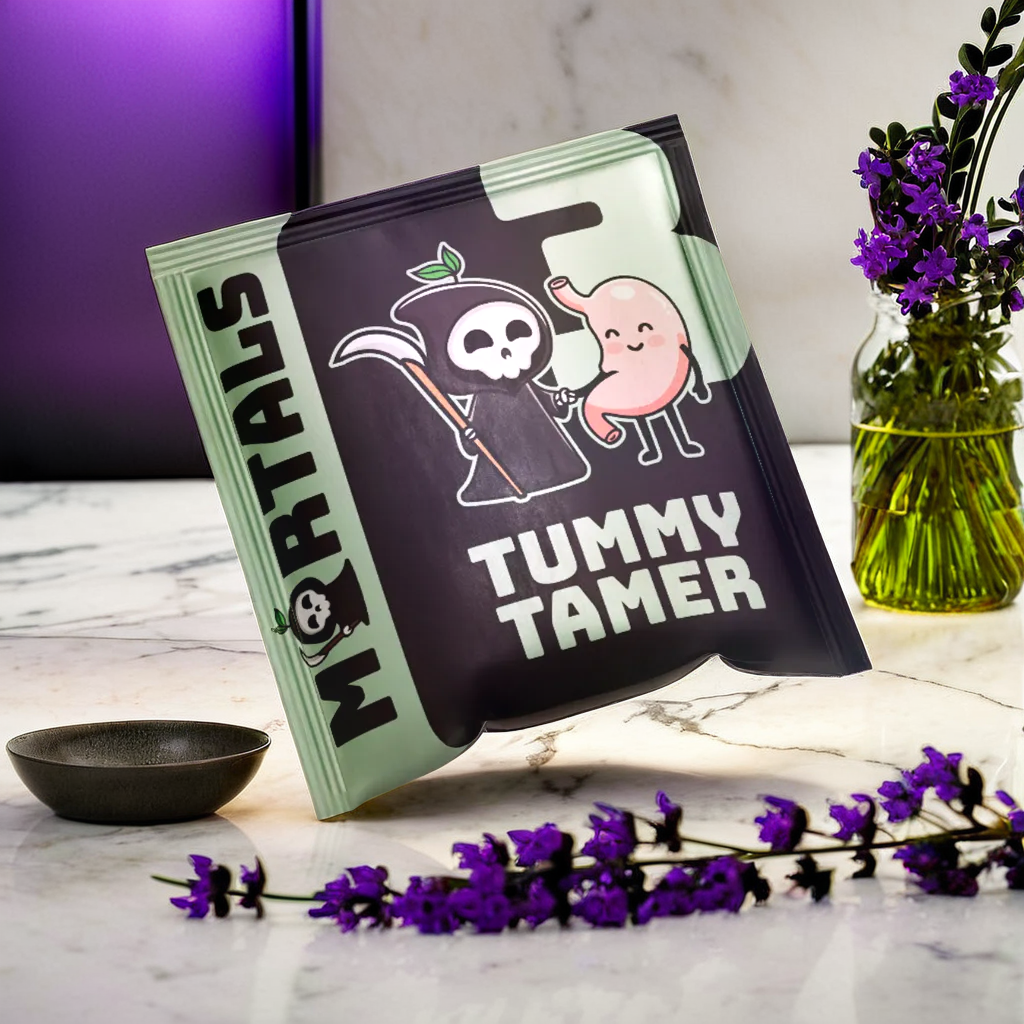
All Mortals products — Anxiety Assassin, Pain Purge, Tummy Tamer, and Cramp Crusher — are single-serve sachets with clinical doses, triple third-party tested, and manufactured in FDA-registered, cGMP-certified facilities in the USA.
The Sustainability Factor
Sustainability is an increasingly important consideration for consumers, and single-serve formats have some surprising advantages:
- Less total packaging material in many cases. A lightweight foil sachet can use less total plastic and material than a rigid HDPE bottle with a cap, seal, and cotton filler.
- Reduced waste from expired supplements. When every dose maintains full potency, you waste less product. How many half-empty supplement bottles have you thrown away because they sat in your cabinet for months? Sachets eliminate that problem.
- Minimalist packaging trending. The supplement industry is moving away from oversized bottles (which are often only half full) toward right-sized packaging that matches the actual product volume.
- Compostable materials on the horizon. Several packaging companies are developing compostable sachet materials that maintain barrier properties while being more environmentally friendly.
Frequently Asked Questions
Are single-serve supplements more expensive?
Per dose, single-serve supplements are often comparable to bottled supplements — and sometimes less expensive when you factor in waste. With bottles, you may lose potency on later doses and throw away supplements you did not finish. With sachets, every dose maintains full potency and you only pay for what you use.
Can you travel with supplement sachets?
Yes — sachets are one of the most travel-friendly supplement formats available. They are TSA-friendly, do not count toward liquid limits, take up minimal space, and do not require you to pack fragile glass or bulky plastic bottles. Many people keep sachets in their carry-on, laptop bag, or even wallet for daily use on the go.
Do sachets keep supplements fresher?
Yes — this is one of the primary advantages. Each dose is individually sealed in a barrier material that protects against air, moisture, and light degradation. Research confirms that storage stability is critical, as vitamins and probiotics are highly sensitive to oxygen, humidity, and temperature (PMC). Unlike bottles where every dose is exposed each time you open the cap, sachets maintain ingredient potency from manufacturing until the moment you open them.
Why do some supplements need so many capsules per serving?
Clinical doses of multiple active ingredients require physical space. A single capsule holds approximately 500-700mg of material. If a formula includes 7-17 ingredients at clinical doses, that requires 2-5 capsules per serving. Sachets make this easy — you open one packet containing the right number of capsules, rather than counting them out of a bottle. Products that claim clinical doses in just 1-2 capsules are almost certainly underdosed.
About the Author
Connor is the founder of Mortals, an all-natural supplement brand committed to clinical doses, transparent ingredients, and single-serve convenience. After years of frustration with underdosed supplements and misleading labels, Connor built Mortals to deliver what the supplement industry has been promising but rarely delivers — products that actually work.
*These statements have not been evaluated by the Food and Drug Administration. This product is not intended to diagnose, treat, cure, or prevent any disease. Always consult your healthcare provider before starting any new supplement regimen.