Written by Connor. Connor is the founder of Mortals, an all-natural supplement brand focused on clinical dosing. After years of frustration with underdosed supplements and misleading labels, he created Mortals to deliver what the research actually supports.
When most people think of chamomile, they think of a mild bedtime tea. It's the "gentle" herb — the one you give to children and grandmothers. But this reputation undersells one of the most clinically studied botanicals for calm, sleep, and digestive comfort.
Modern chamomile supplements deliver concentrated doses of active compounds that a cup of tea simply cannot match. Clinical trials — including several large-scale, long-term studies — show that supplemental chamomile provides meaningful support that goes well beyond what you'd get from steeping a tea bag.
Here's the science behind chamomile supplement benefits, how they work, and why this ancient herb deserves serious attention.
Chamomile: The Basics
There are two main species of chamomile used medicinally:
- German chamomile (Matricaria chamomilla): The most commonly used species in supplements and clinical research. Contains higher levels of the active compounds linked to calming and digestive benefits.
- Roman chamomile (Chamaemelum nobile): More commonly used in aromatherapy and topical applications.
When we discuss chamomile supplements and their clinical evidence, we're primarily referring to German chamomile extract — the species with the strongest research base.
Key Active Compounds
- Apigenin: The star compound. A flavonoid that binds to GABA-A receptors in the brain, producing calming effects. Research (PubMed) has shown apigenin competitively binds to benzodiazepine receptors with anxiolytic activity. This is the primary mechanism behind chamomile's anxiolytic and sleep-supporting properties.
- Bisabolol (alpha-bisabolol): A terpenoid with soothing properties for the digestive tract and skin.
- Chamazulene: Forms during the extraction process and contributes to chamomile's characteristic blue oil. Has notable anti-inflammatory activity.
- Matricin: A precursor to chamazulene with its own biological activity.
- Flavonoids: Including luteolin, quercetin, and patuletin — each contributing additional antioxidant and anti-inflammatory support.
Tea vs. Supplement: Why Concentration Matters
A typical cup of chamomile tea contains approximately 10-30mg of chamomile extract, depending on the tea bag and steeping time. Clinical studies showing significant benefits use doses of 220mg to 1,500mg of standardized extract per day.
That means you'd need to drink roughly 10-50 cups of chamomile tea daily to match the doses used in clinical research. This isn't just a matter of convenience — it's a matter of whether you're getting a pharmacologically meaningful dose or a pleasant beverage with minimal therapeutic impact.
Standardized chamomile supplements also ensure consistent levels of apigenin, the primary active compound. Tea potency varies wildly based on source, processing, water temperature, and steeping time.
Clinical Research: Chamomile for Anxiety and Calm
The University of Pennsylvania GAD Study
The most important chamomile anxiety study was conducted at the University of Pennsylvania and published in the Journal of Clinical Psychopharmacology (2009). In this randomized, double-blind, placebo-controlled trial (PubMed), 57 participants with generalized anxiety disorder (GAD) received either chamomile extract (220mg, standardized to 1.2% apigenin) or placebo for 8 weeks.
The chamomile group showed significantly greater reduction in anxiety scores compared to placebo. The effect size was clinically meaningful — comparable to what's seen with some pharmaceutical approaches.
Long-Term Follow-Up
The same research team published a follow-up study in Phytomedicine (2016) (PubMed) — a 38-week, long-term trial that remains one of the longest chamomile studies ever conducted. Participants with moderate-to-severe GAD who took 1,500mg of chamomile extract daily showed significantly lower GAD symptoms and reduced anxiety relapse rates compared to those switched to placebo.
This study was groundbreaking for two reasons: it demonstrated that chamomile's benefits are sustained over months of use, and it showed no evidence of tolerance (needing higher doses over time for the same effect) — a significant advantage over many pharmaceutical anxiolytics.
Mechanism: How Apigenin Promotes Calm
Apigenin binds to the benzodiazepine binding site on GABA-A receptors, but as a partial agonist rather than a full agonist. This distinction is critical: full agonists (like benzodiazepines) can cause sedation, dependence, and withdrawal. Partial agonists like apigenin produce a gentler modulation — supporting calm without the risks associated with stronger GABAergic agents.
Research has confirmed that apigenin's binding affinity for GABA-A receptors is selective, meaning it promotes calm without significant sedation at standard doses — making it suitable for daytime use.
Clinical Research: Chamomile for Sleep
Sleep Quality in Older Adults
A 2017 randomized controlled trial (PubMed) published in Complementary Therapies in Medicine tested chamomile extract in 60 elderly participants with sleep difficulties. Those receiving chamomile showed significantly improved sleep quality scores on the Pittsburgh Sleep Quality Index (PSQI) compared to placebo over 4 weeks.
Postnatal Sleep
A 2016 study (PubMed) in the Journal of Advanced Nursing found that chamomile tea consumption was associated with improved sleep quality and fewer symptoms of depression in postnatal women over 2 weeks. These findings suggest that even modest chamomile doses may support sleep, with supplements likely providing stronger effects.
Sleep Architecture
Unlike some sleep aids that suppress REM sleep or alter normal sleep cycling, chamomile appears to support natural sleep architecture. Its mechanism — gentle GABA-A modulation via apigenin — promotes relaxation and sleep onset without disrupting the deeper sleep stages important for cognitive function and physical recovery.
Clinical Research: Chamomile for Digestive Comfort
Chamomile's digestive benefits are often overlooked in favor of its calming properties, but the evidence is substantial.
Gut Comfort and Soothing
Bisabolol and chamazulene, two key chamomile compounds, have been shown to support comfortable GI function. A review in Molecular Medicine Reports (2010) documented chamomile's traditional and clinical use for digestive discomfort, noting that its antispasmodic properties may help with occasional cramping and gas.
Gut Lining Support
Research in Phytomedicine has shown that chamomile extracts support the integrity of the gut mucosal lining. This is particularly relevant for individuals whose digestive discomfort involves gut barrier function — an area of growing scientific interest.
The Brain-Gut Connection
Chamomile's dual action on both the nervous system (via apigenin and GABA) and the digestive tract (via bisabolol and chamazulene) makes it uniquely suited for the common overlap between stress and digestive issues. Research increasingly shows that the gut-brain axis means calming the nervous system can directly improve digestive function, and chamomile supports both sides of this equation.
Chamomile in Anxiety Assassin
Anxiety Assassin by Mortals includes chamomile as one of nine synergistic ingredients: ashwagandha, L-theanine, lion's mane, passionflower, L-Tryptophan, chamomile, valerian root, lemon balm, and magnesium.
Chamomile's apigenin-mediated GABA-A modulation complements the other ingredients' mechanisms: ashwagandha's cortisol modulation, L-theanine's alpha-wave promotion, passionflower's chrysin-mediated GABA support, and L-Tryptophan's serotonin precursor activity. This multi-pathway approach addresses calm and stress response from several angles simultaneously.
The formula comes in single-serve sachets designed to start working within 20-45 minutes, and every batch is triple third-party tested in cGMP, FDA-registered facilities in the USA.
How to Choose a Quality Chamomile Supplement
Standardization to Apigenin
The most important quality indicator. Look for extracts standardized to at least 1.2% apigenin — the level used in the landmark University of Pennsylvania studies. Products that don't specify apigenin content may not deliver meaningful amounts.
Extract vs. Powder
Standardized chamomile extract is significantly more potent than simple dried chamomile powder. Extracts concentrate the active compounds while removing inactive plant material.
Species Specification
Ensure the product specifies Matricaria chamomilla (German chamomile), the species with the strongest clinical evidence. Some products use Roman chamomile or don't specify species at all.
Combination Formulas
Chamomile works well in combination with other calming botanicals. Multi-ingredient formulas that include chamomile alongside complementary ingredients like ashwagandha, passionflower, and L-theanine may provide broader support than chamomile alone.
Safety and Considerations
- Generally very well-tolerated: Chamomile has one of the strongest safety profiles among botanical supplements. Mild allergic reactions are the most notable concern.
- Ragweed allergy: Chamomile is in the Asteraceae family, which includes ragweed. Individuals with severe ragweed allergy should use caution, though cross-reactivity is uncommon.
- Blood-thinning medications: Chamomile contains small amounts of coumarin and may have mild antiplatelet activity. Consult your healthcare provider if you take anticoagulants.
- Sedative interactions: At higher doses, chamomile's calming effects may enhance other sedative substances. Use appropriate caution when combining with other calming supplements or medications.
- Pregnancy: While chamomile tea is traditionally considered safe during pregnancy, supplemental doses should be discussed with a healthcare provider.
Frequently Asked Questions
Is chamomile supplement better than chamomile tea?
For therapeutic benefits, yes. Standardized chamomile supplements deliver 10-50 times more active compounds than a cup of tea. Clinical studies showing significant anxiety and sleep benefits used extract doses of 220-1,500mg — far more than tea provides.
How long does chamomile take to work?
For acute calming effects, chamomile extract may work within 30-60 minutes. For sustained benefits — particularly for ongoing anxiety support — clinical studies show optimal results at 4-8 weeks of consistent use, with benefits continuing to build over months.
Can I take chamomile every day?
Yes. The longest clinical study (38 weeks) showed chamomile was safe and effective with daily use and showed no signs of tolerance. Chamomile does not appear to cause dependence or withdrawal effects.
Does chamomile help with both anxiety and sleep?
Yes. The same mechanism (apigenin binding to GABA-A receptors) supports both calm during the day and relaxation at bedtime. The effect depends partly on dose — lower doses may promote calm alertness, while higher doses taken in the evening may support sleep onset.
Can I take chamomile with other supplements?
Chamomile combines well with other calming ingredients. In Anxiety Assassin, chamomile works alongside ashwagandha, L-theanine, passionflower, L-Tryptophan, valerian, lemon balm, lion's mane, and magnesium for multi-pathway support.
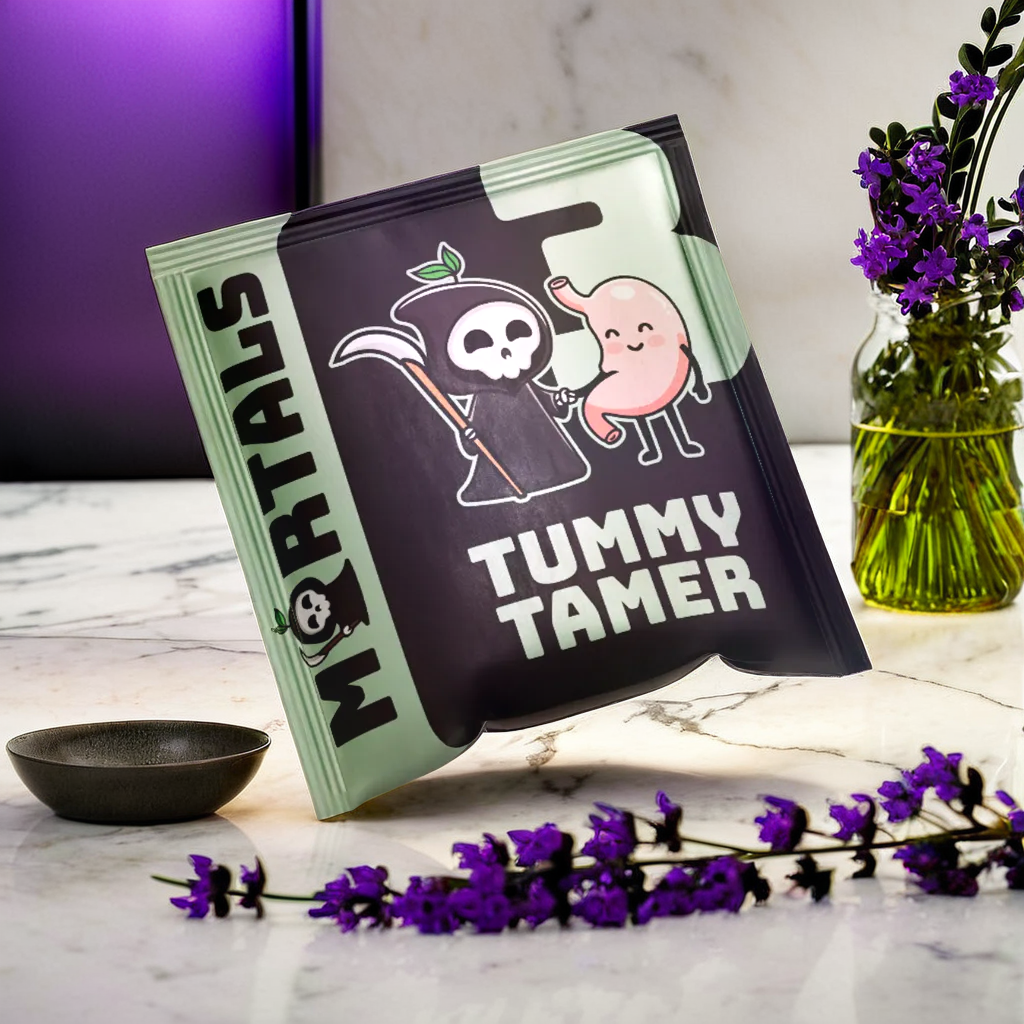
Chamomile also plays a key role in digestive wellness — it is one of the reasons herbal teas are a go-to for stomach comfort. For targeted digestive support, Tummy Tamer combines clinical-dose digestive ingredients with probiotics for fast-acting gut support.
About the Author
The Mortals Team creates all-natural supplements with clinical-dose ingredients, manufactured in FDA-registered, cGMP facilities in the USA. Every Mortals product is triple third-party tested, vegan, non-GMO, and gluten-free. Learn more at trymortals.com.
*These statements have not been evaluated by the Food and Drug Administration. This product is not intended to diagnose, treat, cure, or prevent any disease. Always consult your healthcare provider before starting any new supplement regimen.